Metal Shaping Tools:
The Complete Guide for Restorers & Coachbuilders
Every curve on a car fender, every flowing line of a hand-built panel, starts with the right tools. Metal shaping is the art and craft of turning flat sheet into form, whether you’re restoring a rusted classic, building custom bodywork from scratch, or fabricating precision parts for architectural projects.
At ProShaper, we’ve spent decades in the workshop, teaching thousands of students and tackling projects ranging from rare Ferraris to custom hot rods. Along the way, one thing has become clear: choosing the right tool at the right moment makes all the difference between frustration and success.
This guide covers the essential metal shaping tools you need to know. We’ll look at shrinking tools, stretching tools, and finishing tools. Whether you’re a beginner outfitting your first workshop or a professional refining your process, this complete guide will walk you through the fundamentals and point you to the tools that make the job easier, faster, and more precise.
What Are Metal Shaping Tools?
Definition and Purpose
Metal shaping tools are the instruments used to transform flat sheet metal into custom shapes, curves, and flowing contours. These tools fall into three main categories: stretching tools, shrinking tools, and smoothing/finishing tools. From a simple hammer and sandbag to a precision-built English wheel, each tool plays a specific role in controlling how metal moves.
For automotive restorers, motorcycle builders, and custom fabricators, metal shaping tools are the foundation of turning raw sheet metal into fenders, body panels, and custom parts. Without the right tools, creating accurate curves, compound panels, or restorations would be nearly impossible.
Shaping vs. Fabrication vs. Finishing
It’s common to confuse metal shaping tools with general fabrication equipment. Fabrication usually means cutting, welding, or assembling pre-made pieces. Shaping is about forming sheet metal into new contours without adding or removing material; finishing refines the surface and prepares it for paint.
- A shrinking disc compresses and tightens stretched areas of steel or aluminum.
- An English wheel stretches and smooths curves into place.
- Mallets, hammers, and dollies sculpt metal into shape before finishing.
Once shaping is complete, metal finishing tools remove hammer marks, smooth welds, and prepare panels for primer and paint. Knowing when to shape, fabricate, or finish saves hours and reduces waste.
Shrinking Tools
Shrinking Discs: Steel vs. Phenolic
Shrinking discs are among the most effective metal shaping tools for correcting distortion, warping, or stretched sheet metal. By creating controlled surface heat and cooling it quickly, they pull metal back into alignment without thinning or cutting the panel.
The two main types are stainless steel shrinking discs and phenolic shrinking discs — each designed for different materials and uses.
Want to learn how to use a shrinking disc like a pro? Read our full tutorial: How to Use a Shrinking Disc to Remove Dents and Waves.
Stainless Steel Shrinking Discs
- Made from heavy-duty stainless steel
- Ideal for shrinking steel panels only
- Generate consistent heat for tightening stretched areas
- Long-lasting and durable
- Best choice for restorers or fabricators working exclusively with steel
Phenolic Shrinking Discs
- Constructed from industrial phenolic panels
- Can shrink both aluminum and stainless steel
- Gentler on soft metals like aluminum, helping prevent over-heating
- Essential for mixed-material shops handling aluminum bodywork and stainless projects
- Lightweight and easy to control during long sessions
Heat Shrinking Methods
Heat shrinking is a traditional method of correcting stretched or distorted sheet metal by applying localized heat. The process involves heating a high spot or stretched area until it expands, then cooling it rapidly to contract the metal. This controlled expansion and contraction pulls the metal tight, restoring its original contour.
- Uses a torch, shrinking disc, or induction heater for controlled heat
- Cooling is done with compressed air, a wet rag, or quench spray
- Effective for removing oil-canning or “popped” panels
- Requires practice to avoid over-shrinking or warping
- Often combined with hammer and dolly work for precision results
Heat shrinking is especially valuable in automotive restoration, where aged panels often develop soft spots. When performed correctly, it minimizes filler use and brings the surface back to factory spec.
Mallet Shrinking
Mallet shrinking is one of the oldest and simplest techniques in metal shaping. Instead of using heat, the mallet and shot bag (or stump) compress excess material by striking the panel into itself, forcing the metal to thicken and shrink in the targeted area.
- Involves striking sheet metal into a sandbag, stump, or forming block
- Works best for aluminum and mild steel panels
- Provides hands-on control with immediate visual feedback
- Ideal for beginners learning how metal flows under force
- Can be finished with an English wheel or planishing hammer for smoothness
Though slower than powered tools, mallet shrinking is inexpensive, requires minimal equipment, and gives restorers an intuitive feel for how sheet metal moves — making it an essential skill for every coachbuilder or metal shaping hobbyist.
Stretching Tools
Stretching tools expand sheet metal by thinning and elongating the material, allowing fabricators to create sweeping curves, domes, and complex body lines. Unlike shrinking tools, which tighten and compress, stretching tools work by pulling the metal outward — a key step in forming compound shapes for fenders, hoods, doors, and custom panels.
From simple mallets and sandbags to precision machines like the English wheel and power hammers, each stretching tool provides a different level of control and finish. Beginners often start with hand tools to understand how metal flows under force, while professionals rely on powered equipment for speed, consistency, and large-scale projects.
Stretching is essential for automotive restoration, coachbuilding, and even artistic or architectural metalwork. Mastering these techniques makes it possible to transform flat sheet into flowing contours that look seamless, professional, and factory-correct.
English Wheel
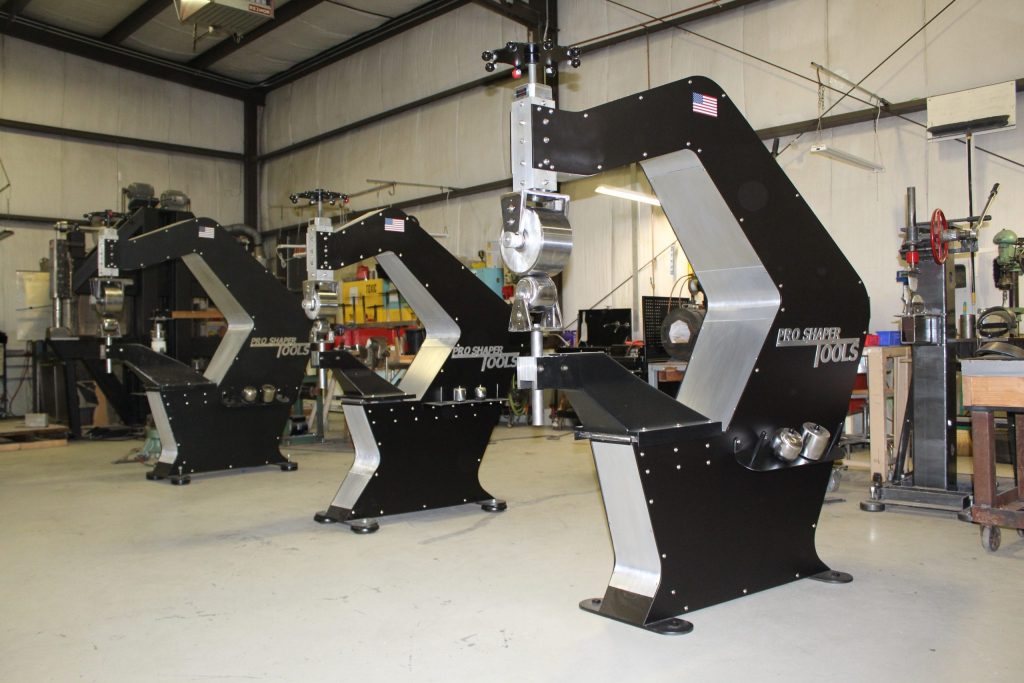
The English wheel is the most iconic stretching tool in metal shaping. It forms smooth curves and compound contours by rolling sheet metal between an upper and lower wheel, gradually stretching the surface. This allows fabricators to create seamless, flowing panels without cutting or welding multiple pieces together.
- Produces long sweeping curves and complex body shapes
- Widely used in automotive restoration, coachbuilding, and aircraft panel work
- Offers fine control over metal flow and smoothness
- Can thin the material slightly as it stretches, requiring precision
- Often used after rough shaping with mallets or hammers for final smoothing
English wheels are the gold standard for professional shops and serious enthusiasts. Shop ProShaper English Wheels to explore our custom-built machines.
Mallets and Sandbags
Mallets and sandbags are the simplest and most accessible stretching tools. Striking sheet metal into a sandbag or leather shot bag forces the metal to expand and curve outward, creating domes, fenders, and flowing shapes. This age-old technique is still widely used today because it teaches beginners how sheet metal reacts to force.
- Affordable, beginner-friendly introduction to stretching methods
- Works well on both aluminum and mild steel panels
- Helps build intuitive control of how metal moves
- Perfect for pre-forming before smoothing on an English wheel
- Different mallet materials (wood, rubber, plastic) achieve different shaping effects
Mallet and sandbag work is cost-effective and essential for understanding the fundamentals of metal movement — skills that carry over to every other shaping tool.
Power Hammers
Power hammers bring speed and consistency to the stretching process. Delivering rapid, controlled blows, they expand sheet metal quickly and efficiently, making them ideal for large-scale projects or high-production environments.
- Significantly reduces time compared to manual stretching methods
- Can be equipped with different dies for both stretching and planishing
- Perfect for forming large or complex panels in coachbuilding
- Requires skill to avoid over-stretching or thinning the material
- Best paired with hand finishing tools for a refined surface
For professionals, power hammers are an investment in speed, precision, and consistency, making them indispensable in modern metal shaping workshops.
Planishing & Finishing Tools
Planishing and finishing tools are used to smooth, refine, and perfect sheet metal after the shaping process. While stretching and shrinking establish the form, planishing and finishing remove hammer marks, blend seams, and prepare the surface for primer, paint, or polish. These tools are essential for achieving the flawless look that separates rough metalwork from professional coachbuilding.
Planishing is the art of delivering many light, controlled blows that gradually even out the surface. This can be done by hand with slappers, dollies, and spoons or with mechanical tools like a planishing hammer. Once the surface is true, files and sanding blocks take care of the fine finishing, ensuring the panel is ready for final coating.
Whether you’re restoring a vintage fender, fabricating a custom motorcycle tank, or building architectural panels, planishing and finishing tools are what turn shaped metal into show-quality work. They’re the bridge between raw shaping and a professional-grade final result.
Planishing Hammers
The planishing hammer is a powered tool that refines panels by delivering thousands of light, consistent blows. Instead of shaping, its purpose is to smooth and even out the metal surface after stretching or shrinking. With adjustable pressure and interchangeable dies, a planishing hammer can take a rough panel from lumpy to flowing in minutes.
Unlike heavy hammering, planishing doesn’t significantly move the metal it simply blends highs and lows, removes hammer marks, and tightens the surface. That’s why it’s often the last step before sanding, filing, or finishing. For restorers and coachbuilders, a planishing hammer is a time-saving upgrade that produces uniform results across large panels.
Slappers, Dollies, and Spoons
Slappers, dollies, and spoons are the hand tools of choice for traditional metal finishers. They offer a tactile connection to the workpiece, letting the craftsman feel each correction as it happens. These tools excel at “reading the panel” — finding high and low spots and nudging them back into place.
Slappers spread the impact across a wider surface than a hammer, making them perfect for leveling metal without leaving deep marks. Dollies act as solid backing forms, while spoons provide long, smooth contact for gentle corrections. Used together, they let a skilled metalworker bring a panel into alignment with precision that machines can’t always match.
This kind of hand-finishing is slower but deeply rewarding, it’s what gives vintage restorations their authentic craftsmanship feel.
Files and Sanding Blocks
Once the panel is shaped and planished, files and sanding blocks provide the fine finishing needed to prep for paint. A vixen file will reveal highs and lows by cutting only the raised areas, guiding the metalworker to where further smoothing is required. Sanding blocks then refine the surface, blending away file marks and leaving the metal uniform.
This stage isn’t glamorous, but it’s critical: a poorly finished surface will telegraph imperfections straight through primer and paint. Mastering the use of files and blocks ensures that the final panel looks factory-straight under any lighting.
Choosing the Right Tool for the Job
Selecting the right metal shaping tool depends on the project, the material, and your level of experience. No single tool does it all — shrinking, stretching, and finishing each have their place, and the right combination ensures precision, efficiency, and professional results.
Shrinking vs. Stretching
Every project balances shrinking and stretching. Shrinking compresses and tightens stretched areas, while stretching expands and curves the panel outward. Understanding when to use each process saves hours of unnecessary work and prevents distortion.
- Shrinking tools (like shrinking discs and mallet techniques) correct distortion, warping, and oil-canning.
- Stretching tools (like English wheels and sandbags) expand the metal to form curves and contours.
Project Size and Tool Selection
The scale of your project should guide your tool choices:
- Small projects — hand tools (mallets, dollies, slappers) often provide the best control.
- Larger panels — machines like the English wheel or a planishing hammer ensure consistency over long curves.
- Restorations — shrinking discs and planishing tools help bring aged metal back to life with minimal filler.
Starter Kits vs. Professional Setups
Not every shop needs industrial machinery on day one. Beginners can achieve excellent results with a starter kit of essentials:
- A shrinking disc
- A mallet and sandbag
- A few dollies and slappers
As your skills grow, adding an English wheel or planishing hammer dramatically expands what you can build. Professionals often keep a mix of hand tools and powered equipment to cover every stage of shaping and finishing.
At ProShaper, we recommend starting with the basics and building your toolkit as your confidence grows. Learn with ProShaper Classes or shop our tools to find the right setup for your goals.
Real-World Applications
Metal shaping isn’t just about tools — it’s about the projects they make possible. From restoring vintage cars to creating one-off custom builds or even designing architectural accents, metal shaping tools are used anywhere form and function meet. At ProShaper, we’ve seen students and professionals alike use these techniques to breathe new life into steel and aluminum.
Automotive Restoration
Classic car restoration is one of the most common applications of metal shaping. Rusted or damaged panels often can’t be bought off the shelf, so fabricators must recreate them by hand. Tools like the shrinking disc, English wheel, and planishing hammer make it possible to duplicate factory curves and compound shapes with precision.
- Rebuilding rusted fenders and quarter panels
- Repairing oil-canning hoods and doors
- Fabricating hard-to-find panels for rare models
Coachbuilding Projects
Coachbuilding is the art of creating custom car bodies from scratch — a field where ProShaper has decades of experience, from rare Ferraris to hot rods. Stretching tools like the English wheel are combined with shrinking discs and mallets to form flowing body lines that look as if they rolled out of a factory, even though they were hand-built.
Coachbuilding relies on both traditional hand techniques and modern powered tools. The balance of skill and equipment determines how efficiently panels can be shaped, smoothed, and finished.
Architectural and Artistic Work
Metal shaping extends far beyond cars. Artists, furniture designers, and architects use these same tools to create unique installations, sculptures, and functional designs. Curved aluminum panels, decorative copper, and stainless steel accents are all shaped using the same shrinking, stretching, and planishing methods found in auto shops.
This crossover between industries shows the versatility of metal shaping — whether you’re restoring history, building the future, or creating art that stands out.
Getting Started with Metal Shaping
Starting your journey in metal shaping doesn’t require a full workshop of machines. With just a few essential tools and the right workflow, beginners can start forming panels, correcting distortion, and building confidence in how sheet metal moves. The key is to begin small, practice often, and grow your skills step by step.
Essential Starter Tools
A beginner doesn’t need every tool in the catalog. A focused starter set allows you to learn how shrinking, stretching, and smoothing really work:
- Shrinking disc for correcting stretched or warped panels
- Mallet and sandbag for basic shaping and stretching
- One or two dollies or slappers for refining curves
This combination alone lets you practice the fundamental movements of metal shaping without a big investment.
Recommended Beginner Workflow
The best way to learn is by working through a simple, repeatable process. Beginners often start with flat sheet and practice shaping small domes or curves. A suggested workflow might look like this:
- Rough-shape the panel with a mallet and sandbag
- Stretch and smooth curves using an English wheel or dolly
- Shrink high spots with a disc to correct distortion
- Finish with light planishing and filing to true the surface
Repeating this workflow on small projects gives you the muscle memory and confidence to take on larger restorations or custom builds.
Learn in a 1-on-1 Metal Shaping Class
While tools are important, nothing accelerates progress like personal instruction. At ProShaper, we offer a unique 1-on-1 workshop program where students do 95% of the hands-on work under the guidance of master coachbuilder Wray Schelin. This immersive experience lets you learn proper technique, avoid common mistakes, and walk away with real-world skills you can use immediately.
Whether you’re restoring a classic, building custom bodywork, or just starting out, our classes provide the fastest path to mastery. Learn more about ProShaper’s 1-on-1 classes and take the first step toward becoming a skilled metal shaper.
Conclusion
Every successful restoration, custom build, or artistic project begins with the right metal shaping tools. From shrinking discs and mallets to English wheels and planishing hammers, each tool plays a role in turning flat sheet into flowing form. Mastering when and how to use them is the foundation of success in metal shaping.
Remember: you don’t need every tool to start. Begin with a few essentials, practice the basic techniques, and add to your workshop as your skills and projects grow. The journey from first strike on a sandbag to hand-forming complex panels is one of the most rewarding parts of the craft.
If you’re ready to take the next step, ProShaper can help. Shop our professional tools to equip your workshop, or learn hands-on in our 1-on-1 metal shaping classes with master coachbuilder Wray Schelin. Whether you’re a beginner or a seasoned fabricator, we’ll give you the tools and knowledge to succeed.
[…] Metal Shaping Tools Guide […]